English
 español
 العربية

Under the background of "dual carbon" goals, heat pumps have become the mainstream in cooling and heating retrofits in residential and commercial buildings. While many hosts will hesitate whether choosing a ground-source heat pump or an air-source heat pump.
Many people refer to the COP value on the paper only, mistakenly regarding that the ground-source heat pump is absolutely better than the air-source heat pump. In actual projects, large ground-heating projects are limited by site conditions, geology, and high initial investment costs. There are also normal air-source heat pumps with decreasing performance in extremely cold areas.
The air-source heat pumps utilize exterior air as the source in the heat-exchanging procedure. Same as traditional air conditioners, they consume electricity to transfer heat from the air. They extract heat from the air for heating in winter and exhaust indoor heat to the outdoors for cooling in summer.
Drawbacks: Outdoor temperatures deeply affect its performance; frosting occurs in cold environments—requiring additional energy for defrosting—and heating efficiency drops significantly in extreme cold.
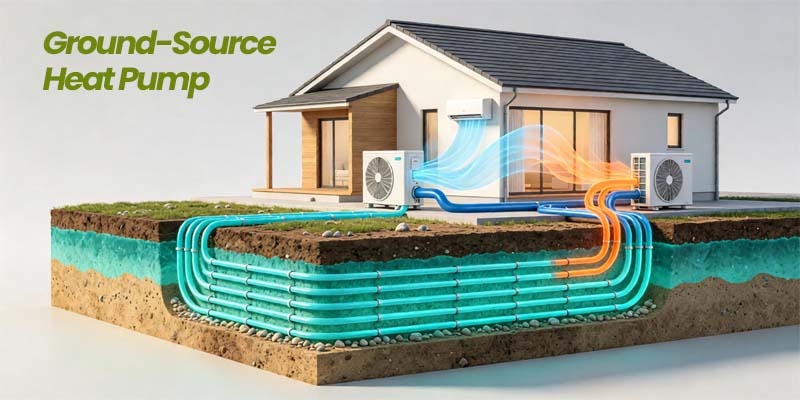
The ground-source heat pumps (closed-loop soil-source system) exchange heat with shallow underground soil via buried piping. The temperature of soil remains stably at 10–18°C normally, hardly ever affected by seasonal fluctuations in ambient air temperature. It extracts heat from the soil in winter and deposits heat from the building into the soil in summer, creating a heating and cooling cycle.
Advantages: stable annual Coefficient of Performance (COP) with minimal performance degradation during extreme cold or heat; underground piping lifespan of up to 50 years. But in installation, it will use more piping under the ground or drilling. It is a huge project, which is not just to buy equipment.
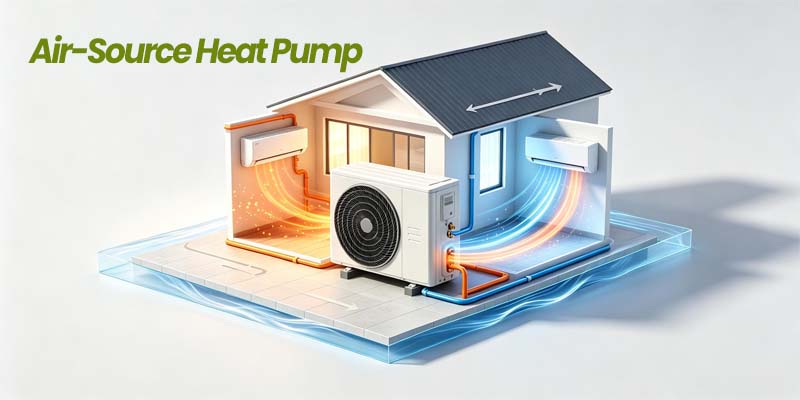
Air-source heat pumps: With a small starting charge, the heat pump units require only an outdoor unit without necessitating well-drilling or large-scale excavation. Fast installation, they are suitable for many building scenarios, such as retrofitting existing homes and high-rise residential buildings.
Ground-source heat pumps: Except for the unit cost, there are additional charges for drilling, installing underground piping, and conducting geological surveys. The total cost at the beginning is almost 1.5 to 2 times that of air-source systems. They are suitable for new construction projects but are difficult to implement in existing buildings due to site constraints.
Air-source heat pumps: Their performance is excellent in regions with hot summers and cold winters. However, in extreme cold (temperatures under -10 to -15°C), energy efficiency drops significantly, and defrosting cycles will increase electricity costs. In the meantime, cooling capacity also experiences a slight decrease under the extreme hot ambient temperature.
Ground-source heat pumps: They are mostly affected by ambient temperatures; instead, they could deliver stable output in both extreme cold and extreme heat, resulting in lower long-term electricity costs. While the system includes a ground-side water pump, which incurs a certain amount of fixed energy consumption, additionally, a long-term imbalance between heating and cooling loads can cause soil temperature drift, leading to a gradual decline in energy efficiency over time.
Air-source heat pumps: The machine is put outside of the house; the noise will be generated from the compressor and fan blade. This makes the noise reduction measures necessary for low-rise residences or when the unit is located near a bedroom.
Ground-source heat pumps: The heat-exchange parts are put under the ground, and the equipment is put in a designated room or place. There is no noise outside that makes it more quiet, suitable for vellas, hotels, hospitals, and other noise-sensitive places.
Air-source heat pumps: Simple maintenance; we only need to clean the heat exchanger and check if the refrigerant is sufficient. The machine has a lifespan of around 15-20 years. The supply chain is mature, which makes aftersales service more convenient.
Ground-source heat pumps: Maintenance-free for the underground pipes, we just need to care about the machine. The installation quality at the beginning directly determines the performance in the coming decades. The leakage of the underground pipes will bring difficulties to the maintenance and fixing, which requires highly professional teams for the installation.
Residential scenarios: The exceeded cost for the ground-source system normally needs 5-8 years to pay back. If the planned utilization period for the house is no more than 5-8 years, then the recovery of the cost is a bit hard.
Commercial scenarios: The operation is continuous all year round in hospitals, schools, hotels, etc. The ground-source heat pumps have stable loads, which makes their payback period shortened to 4-6 years with a considerable profit in the long term. For small shops and short-term rental projects, the air-source heat pump is more cost-effective.
A tip for homeowners: Do not blindly fixate on the higher COP of ground-source systems. The additional energy consumed by water pumps and the high cost of drilling boreholes can erode some of the electricity savings; furthermore, if the site lacks sufficient space or has poor geological conditions, forcing the installation of a ground-source system will significantly compromise its performance.
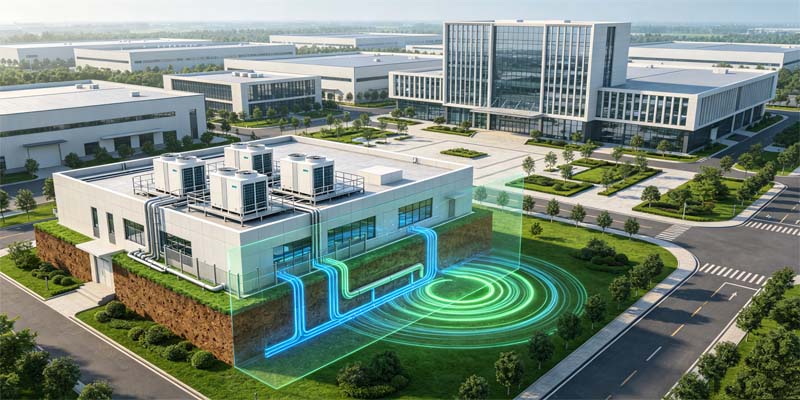
Commercial Pitfall Avoidance: Ground-source heat pump systems do not automatically become more efficient over time. If the building's cooling load in summer significantly exceeds its heating load in winter (or vice versa), thermal imbalance in the soil occurs; this leads to a continuous decline in system efficiency after a few years. Therefore, at the beginning, we need to calculate the thermal balance. If necessary, auxiliary cooling towers or heat dissipation equipment are needed.
There is no single "perfect" solution; the choice replys on three key factors: site availability, the intended service life, and the budget.
Many projects employ hybrid systems—pairing a ground-source system with an air-source auxiliary unit—to balance initial investment costs against operational energy efficiency; this has become the prevailing approach for commercial projects. Before final implementation, it is advisable to conduct a comprehensive life-cycle cost analysis that takes local climate and geological conditions into account.
We are a professional heat pump manufacturer; if you have any questions about our products, please feel free to contact us!


Copyright @ 2026 GUANGZHOU SOUXIN APPLIANCES CO., LTD All Rights Reserved.
 Network Supported
Sitemap / Blog / Xml / Privacy Policy

Hi! Click one of our members below to chat on