English
 español
 العربية

Thri-generation heat pump, fully named the air-source heat pump system for cooling, heating, and domestic hot water, uses one outdoor unit to deliver these three functions at the same time. Recycling waste heat to generate hot water when cooling in summer is its primary selling point. However, it is not a universal solution for all families. A proper model for home would save money and deliver comfort, while a wrong choice would lead to high investment and complex aftersales.
For new homes, pre-installation for water piping, equipment rooms, outdoor unit places, and water tank places can be finished simultaneously. The room size is usually 120 sq. m and above, which needs a high load of whole room cooling/heating, stable ground heating, and an abundant hot water supply in case of large families. The tri-generation heat pump could utilize its advantage for large household families with such high-demand hot water conditions.
The initial costs for the equipment and the piping installation would be more expensive than traditional heat pumps (heating and hot water supply). Only by long-term residence with longer operation could the initial costs be amortized and long-term energy savings realized.
Air conditioners, wall-hung boilers, and water heaters will occupy more spaces outside. If we use a tri-generation heat pump, we could save more space, and the building exterior would be more pleasant.
In hot areas, the air conditioners should be opened for a long period. The energy-saving performance by heating water with recovered heat is most pronounced, leading to tangible reductions in hot water energy consumption.
A tri-generation heat pump is more complex, which relates to the heat exchanger of domestic hot water, the water tank, anti-corrosion measures for piping, and water filtration. Reliable design, installation, and after-sales service are prerequisites for stable system operation.
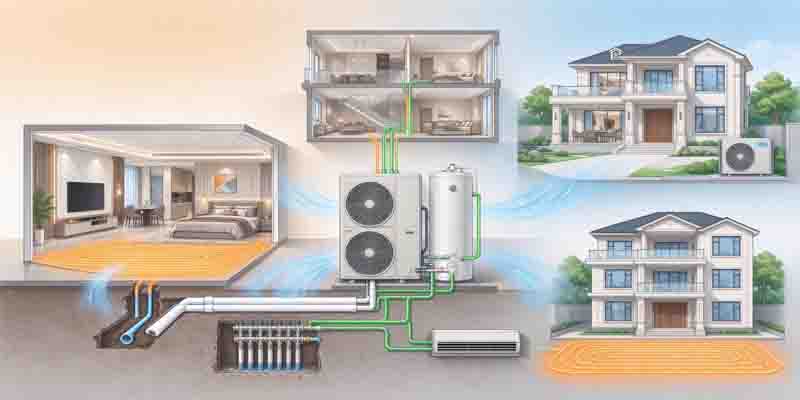
A tri-generation system heat pump requires plenty of piping work, and also the place for the water tank is needed. If we renovate the house after the completion of construction, then the ceiling will be broken, which will lead to massive workloads and exorbitant costs. In this condition, a heat pump system with an individual hot water supply system is a good choice.
Small homes have a low cooling/heating load, hot water generated in summer often goes unused, and the system needs to raise up the water temperature when generating hot water in non-summer seasons, resulting in the decrease of the system's COP and not being energy-saving.
The purchase for the tri-generation system, piping, water tank, and control system is higher than traditional heat pumps. It is suggested to use a traditional system with an individual water heater, which features simple installation and fewer malfunctions.
The heat exchanger in the domestic hot water system is easily scaled and corroded. Water with low quality will influence the lifespan of the heat exchanger and even damage the heat pump unit. If water treatments like filters or scale-prevention equipment cannot be installed, then it is not recommended to use a tri-generation heat pump system.
With the high initial cost, the second-hand properties could hardly recover the cost of the tri-generation system. It's not cost-effective.

The core advantage of the tri-generation heat pump system is to recover the waste heat to generate hot water in the summer cooling procedure. It is suitable for homes with a large scale, with more family members, newly built with long-term residence, and with high demand for hot water.
For houses with small scale, completed renovation, less demand for hot water, and limited space for a water tank, the best option is a traditional heat pump system (air conditioning and ground heating) with individual hot water equipment. It features a simple system with fewer malfunctions and easy maintenance.


Copyright @ 2026 GUANGZHOU SOUXIN APPLIANCES CO., LTD All Rights Reserved.
 Network Supported
Sitemap / Blog / Xml / Privacy Policy

Hi! Click one of our members below to chat on