English
 español
 العربية

Energy costs keep fluctuating. That leaves many households and commercial operators asking a critical question when selecting heating systems:
For many years, gas boilers have been heavily used throughout Europe and many other countries. Air-source heat pumps have gained much popularity in recent years owing to their greater efficiency and wider scope of applications. When evaluated based on long-term use, what are the differences from a traditional gas boiler?
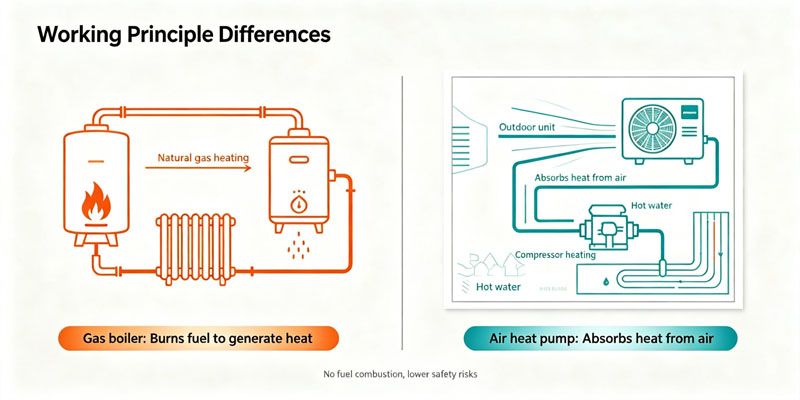
A gas boiler creates heat and transfers that heat to the building through a heating system by burning natural gas.
A heat pump unit works differently. Rather than creating heat from scratch, it absorbs heat from ambient air, then boosts and circulates this heat via a compressor and heat exchanger system.
To put it simply:
Gas boiler: Produces heat through fuel combustion
Air-source heat pump: It runs primarily on electricity to drive the compressor and control modules. No fuel is burned during operation. This cuts emissions from combustion and delivers better energy efficiency.
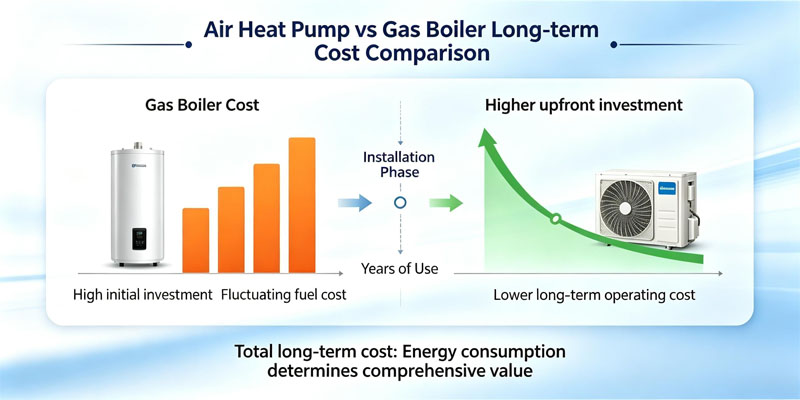
Traditional gas boilers tend to be the cheaper option at the installation stage.
This technology has been mainstream for decades. Installation procedures are well established and straightforward, resulting in a smaller upfront spend.
By comparison, a heat pump unit usually requires an outdoor unit, hot water storage tank, and related heating system components, resulting in a higher upfront cost.
However, a heating system is not a one-time purchase.
For hotels, residences, and commercial buildings that have used heating systems for many years, energy consumption is one of the most important factors that affect total ownership cost. The price of gas, oil, or electricity needed to run the heating system is a factor of energy consumption.
One of the prominent features of an air-source heat pump is that it uses free heat from the air.
During operation, electricity is mainly used to drive the compressor and control system, rather than directly generating heat like traditional electric heating equipment.
A heat pump, under adequate operating conditions, will ordinarily produce more heating output with less input, which is useful to reduce long-term energy.
For instance, our air-source heating pump systems are designed with optimized compressors and heat exchange technology to ensure stable performance in colder environments. There are some models that can run in temperatures as low as minus 35 degrees.
For areas with longer winters and higher heating demand, the long-term energy-saving benefits can become more noticeable.
Gas boilers rely on continuous fuel combustion to work. This means users need routine inspections for gas pipelines and exhaust systems to prevent potential safety hazards.
In comparison, air-to-air heat pumps operate without any fuel burning or open flames. They eliminate combustion-related risks entirely and deliver much simpler daily operation.
Modern heat pumps also perform far better in terms of noise control. Optimized compressor and fan designs greatly reduce operating sound levels. This makes them ideal for residential houses, hotels, and other spaces that demand a quiet and comfortable environment.
When it comes to upkeep, today’s heat pump systems feature solid, mature structures. Only routine checks and basic servicing are required to keep the unit running steadily year after year.
If you’re looking to cut energy expenses, secure consistent heating performance, and get an all-in-one system for heating and hot water, an air-source heat pump is a practical choice.
It delivers the best value, especially in the following scenarios:
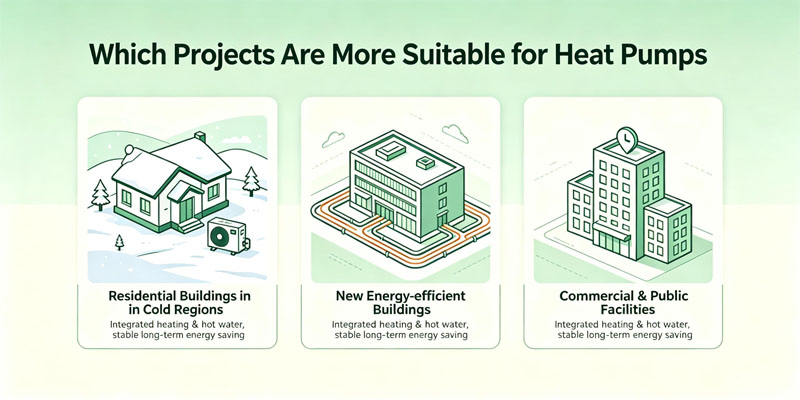
Homes in Cold Climate regions
Areas with long winter heating cycles benefit the most. Heat pumps leverage advanced low-temperature adaptability and high energy efficiency to keep running reliably throughout the cold season.
New Energy-Saving Buildings
Properties fitted with underfloor heating or low-temperature heating layouts pair extremely well with heat pumps, bringing out the best overall system performance.
Commercial and Public Facilities
Hotels, schools, and apartment complexes constantly need both space heating and domestic hot water. Heat pumps offer a unified, cost-effective system to cover both demands perfectly.
Gas boilers come with lower upfront costs, but air-source heat pumps outperform them in energy efficiency, running expenses, and system versatility in the long run.
With energy efficiency and cost savings becoming higher priorities for households and businesses, heat pumps are fast becoming the preferred heating solution for residential and commercial properties.
For anyone seeking consistent heating and hot water while aiming to cut energy usage, air-source heat pumps make a practical solution.


Copyright @ 2026 GUANGZHOU SOUXIN APPLIANCES CO., LTD All Rights Reserved.
 Network Supported
Sitemap / Blog / Xml / Privacy Policy

Hi! Click one of our members below to chat on